A finish is not the last step — it is a design decision. These notes cover what plating and coating actually do to your parts, how to choose the right process, and what we need from you to get it right the first time. Send us the print before you release it: we would rather solve it on the drawing than on the dock. Gleco Plating reviews finish callouts at no charge.
Electroplated deposits build heavier on edges, corners, and outside radii than on flat faces. A surface called out at .001″ can measure closer to .002″ on an edge. Radius your corners generously and put the tolerance where you actually need it.
2. Threads grow about four times the plate thickness
Plating lands on every flank of a thread, so the pitch diameter grows roughly four times the deposit thickness. Account for it in your class of fit — otherwise the hardware will not go together.
3. Deep and blind holes will not plate evenly
Electroplating does not throw far into a hole; coverage falls off past roughly one diameter of depth. If a bore, blind hole, or internal thread needs uniform thickness, use electroless nickel — it deposits without current and does not care about line of sight.
4. Hard anodize grows AND eats into the part
Hardcoat converts the aluminum rather than just sitting on it: roughly half builds up and half penetrates. A .002″ hardcoat adds about .001″ per surface, so a bore closes and a shaft grows. Machine for it — hardcoat is never dimensionally free.
5. Blasting changes the surface, not just the look
Glass bead, aluminum oxide, and sand each leave a different profile and remove a different amount of material. If you have a critical surface finish or a tight dimension, tell us and we will pick the medium to match it.
Material & Process
Choosing the right finish for the metal and the duty.
6. High-strength steel needs an embrittlement bake
Steel at roughly Rockwell C39/40 and above is at risk of hydrogen embrittlement, and the post-plate bake has to start promptly — not next shift. Call it out on the print. Steels above 1700 MPa should not be zinc electroplated at all (ASTM B633 sec 1.4).
7. Shot peen before plating — never after
If fatigue life matters, peening comes first. Peening a plated part defeats the purpose and damages the deposit. Put the peening standard on the drawing so it lands in the right place in the routing.
8. Match alloy and finish across an assembly
Anodize color shifts with alloy and temper. If mating parts have to look the same, specify the same alloy and the same finish from the same source, and settle your hardware before the parts are anodized or chem filmed.
9. Do not over-specify thickness
Thickness drives cost, dimensional change, and lead time all at once. Pick the service condition you actually need — mild, moderate, severe — rather than defaulting to the heaviest class because it sounds safer.
10. Ask before you commit to a spec
Some combinations simply do not work: a material that will not passivate, an alloy that will not anodize to the color you want, a thickness that closes a tolerance. We would rather flag it on the drawing than after the lot is run.
Working With Gleco
Capacity, logistics, and how to spec for our shop.
11. We run parts up to 750 lbs
Our largest tanks reach 120″ x 36″ x 72″, and we process parts up to 750 lbs. If your part is large, heavy, or awkward, send the envelope early — we will tell you straight away whether it fits the line and which tank it runs in.
12. Mask only what must stay bare
Masking is hand work and it adds cost. Mark the surfaces that must stay unplated — bearing journals, sealing faces, contacts, threads — directly on the print. A clear callout beats a paragraph in the notes every time.
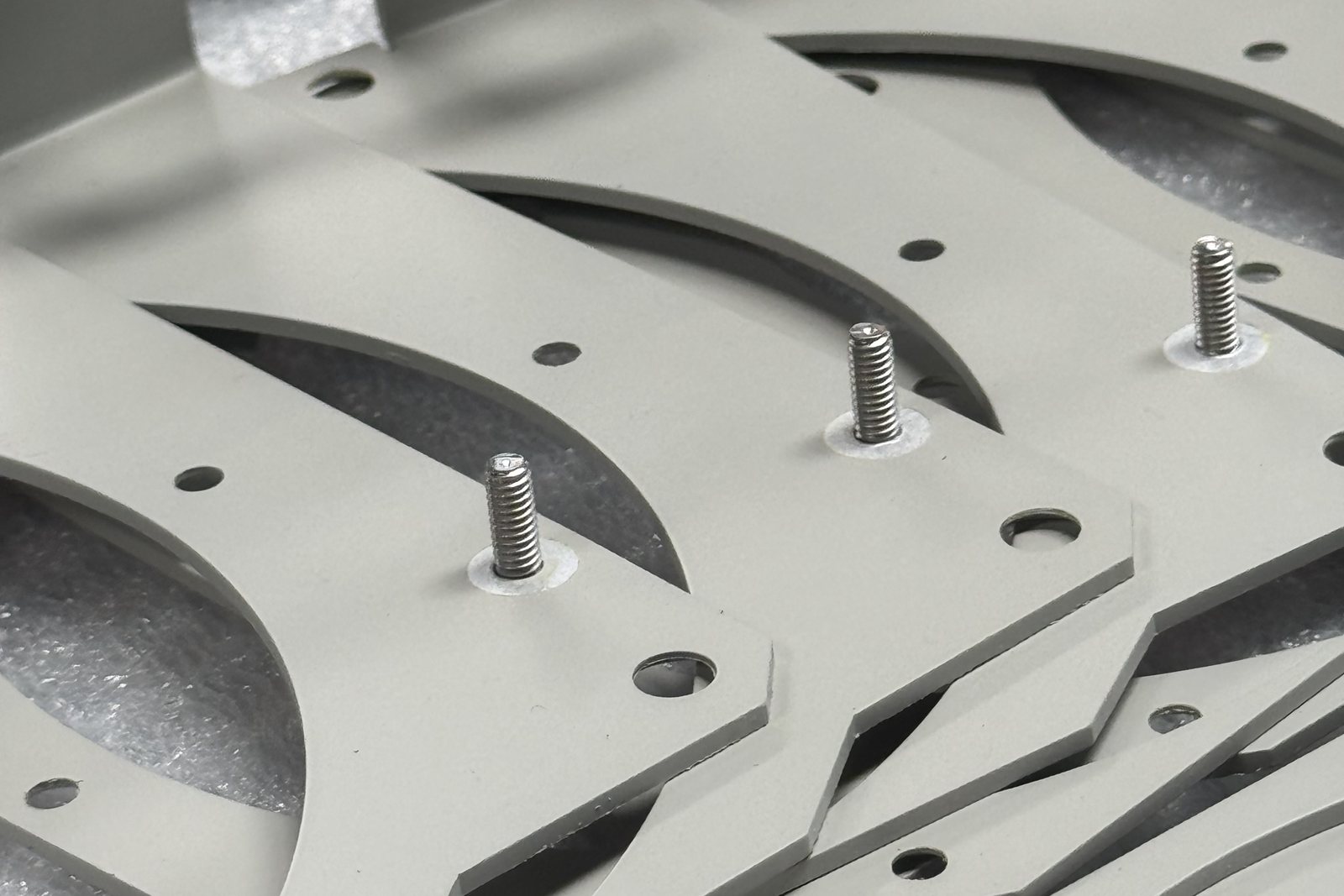
Threaded studs masked before coating. Tell us on the print which surfaces must stay bare — threads, bearing diameters, electrical contact faces — and we will mask to it.
13. Finish comes last — tell us what comes after
Plating and coating follow machining, forming, welding, and stress relief. But if the part gets painted, bonded, soldered, or pressed after finishing, say so — it changes the pretreatment and sometimes the finish we would recommend.
14. One shop, plating through paint
Plating, anodize, passivation, paint, powder, dry film lube, Cerakote, and blasting all run under one roof across our Rowlett and McAllen facilities. Routing a multi-process part through one supplier removes the handoffs where parts get damaged and schedules slip.
15. Send parts clean, protected, and documented
Handle parts with gloves — skin oils and fingerprints turn into rejects downstream. Ship them separated and undamaged, with the drawing, specification, revision, type, and class identified. Missing paperwork is the most common reason a job sits.
16. We test in-house
Both locations run full labs for wet analysis and hull-cell testing, so bath chemistry is verified continuously rather than assumed. If your part needs documented results, ask up front and we will build the testing into the job.
Substrates We Process
The metals we finish and what we run on them. We also work to a wide range of additional AMS, ASTM, MIL, and QQ specifications — if you do not see yours, ask us.
Plating lands on every flank of the thread, so the pitch diameter grows roughly four times the deposit thickness. Account for this in your class of fit so the hardware still assembles.
How should I plate a deep or blind hole?
Electroplating throws poorly into holes — coverage falls off past about one diameter of depth. For uniform thickness in a bore, blind hole, or internal thread, use electroless nickel, which deposits chemically without regard to line of sight.
Does hard anodize change part dimensions?
Yes. Hardcoat converts the aluminum: about half builds up and half penetrates. A .002″ hardcoat adds roughly .001″ per surface, closing bores and growing shafts. Always machine to allow for it.
When is a hydrogen embrittlement bake required?
For steel at approximately Rockwell C39/40 and above. The post-plate bake must begin promptly, and it should be called out on the print. Steels above 1700 MPa should not be zinc electroplated at all.
Should I shot peen before or after plating?
Always before. Peening establishes the compressive layer that improves fatigue life; peening after plating damages the deposit and defeats the purpose. Put the peening standard on the drawing.
What is the largest part Gleco can plate?
Our tanks reach 120″ x 36″ x 72″ and we process plated parts up to 750 lbs. For blasting and paint we handle unlimited-size parts. Send the part envelope early and we will confirm the fit.Send us the print before you release it. Call (972) 475-4300 or submit an RFQ and we will review your finish callouts at no charge. ISO 9001:2015 & AS9100D certified. ITAR Registered.
Download Our Linecard & Spec Charts
Keep our full capabilities on file. These reference sheets list every finish, applicable AMS/ASTM/MIL/QQ specification, tank sizes, and the substrate matrix.